
When High Performers Become a Threat
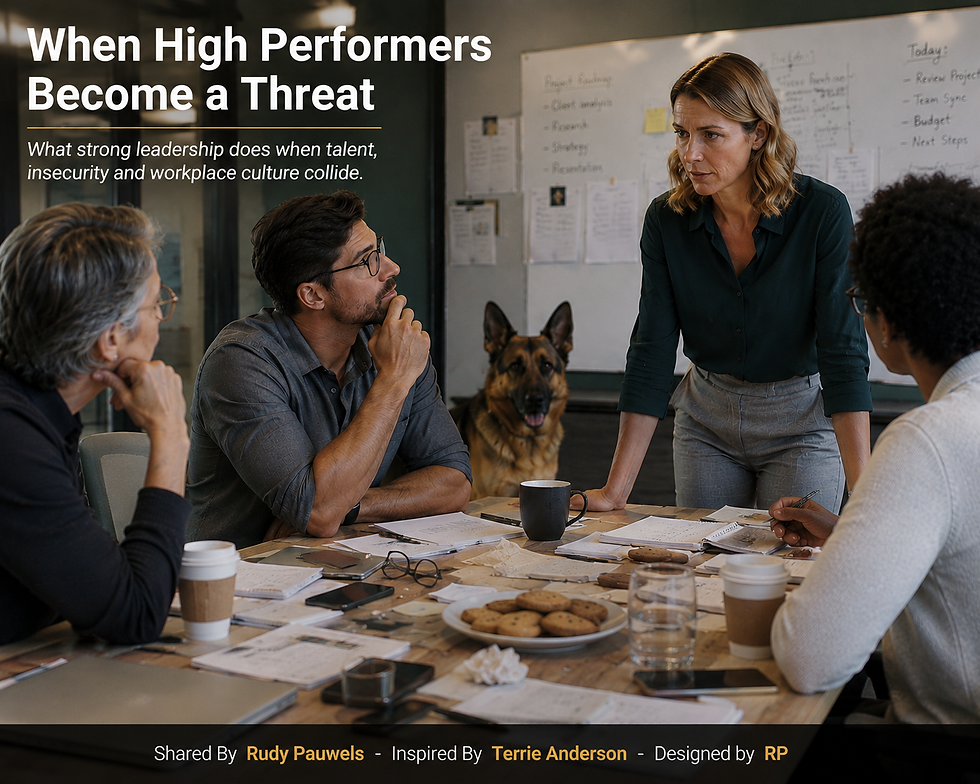
What strong leadership does when talent, insecurity and workplace culture collide
High performers are usually considered an organisation’s greatest asset. They bring energy, ideas, confidence and results. They often see possibilities before others do, question inefficient processes and raise the standard of what can be achieved.
But high performers can also become a threat.
Sometimes they become a threat because their behaviour begins to damage the people around them. Sometimes they are only seen as a threat because their ability exposes weak leadership, outdated thinking or a manager’s insecurity.
The difference matters.
Over the years, working alongside Terrie and watching her lead people, I learned that leadership is not simply about recognising talent. It is also about understanding what talent does to the dynamics inside a team.
A confident leader is usually strengthened by capable people. An insecure leader can feel diminished by them.
That is where the problem often begins.
Why High Performers Become a Threat to Insecure Leadership
A genuine high performer does more than complete tasks quickly. They notice what is not working. They ask questions. They challenge assumptions. They see gaps in processes and often suggest a better way forward.
To a secure leader, this can be enormously valuable.
To an insecure leader, the same behaviour can feel like criticism.
The leader may begin wondering whether the high performer is becoming too influential, too visible or too respected by others. Instead of seeing their ability as something that strengthens the team, the leader starts interpreting it as competition.
This does not always happen openly.
The high performer may slowly stop being invited to important conversations. Their suggestions may be ignored until someone else repeats them. Opportunities that once seemed likely may quietly disappear. Their confidence might be described as arrogance, while the same confidence in someone less capable is accepted without question.
Eventually, the high performer receives a message, whether anyone says it directly or not.
You are valuable, but only while you remain small enough not to make anyone uncomfortable.
This is one of the quietest ways organisations lose talented people.
The person may not resign immediately. They may first reduce their effort. They stop presenting ideas. They contribute only what is requested. They learn that initiative creates resistance rather than opportunity.
By the time they finally leave, management may say they became disengaged.
Few people ask what caused the disengagement.
High performers do not always leave because another organisation offers more money. Sometimes they leave because staying requires them to become less capable, less visible and less honest about what they can see.
When Performance Is Used to Excuse Harmful Behaviour
There is another side to this conversation.
Not every high performer is a misunderstood employee being restricted by insecure leadership. Some high performers genuinely become a threat to the workplace culture around them.
They may produce impressive numbers while creating fear, tension or division within the team. They might take credit for the work of others, withhold information, undermine colleagues or behave as though ordinary standards no longer apply to them.
Because they deliver results, the organisation protects them.
Their behaviour is explained away as confidence, passion or a strong personality. People are told not to take things personally. Managers hesitate to confront them because they are worried about losing their output, their clients or their specialist knowledge.
The message to the rest of the team becomes very clear.
Results matter more than respect.
This is where a high performer becomes dangerous.
Their individual success may look impressive on a report, but the hidden cost appears elsewhere. Other employees become quieter. Collaboration decreases. Good people leave. Mistakes are hidden because nobody wants to attract criticism. Trust begins disappearing from the room.
The organisation may still be performing, but it is slowly becoming dependent on one person and increasingly vulnerable because of them.
A high performer who damages everyone around them is not creating sustainable success. They are borrowing performance from the future and leaving somebody else to repay the cost.
Strong leadership does not ignore results, but it also does not measure performance through numbers alone.
How the results are achieved matters.
The strongest performer in a team should not be given permission to weaken the team itself.
The Difference Between Being Challenged and Being Undermined
Leaders need enough self awareness to recognise the difference between discomfort and danger.
A high performer who asks difficult questions is not necessarily undermining leadership. They may be trying to prevent a mistake.
A person who disagrees with a decision is not automatically being disloyal. They may care enough about the organisation to say what others are afraid to say.
A team member who has greater knowledge in a particular area is not trying to take over. They may simply have something important to contribute.
The leader’s responsibility is to look beyond the emotional reaction and examine the behaviour honestly.
Is this person improving the conversation or controlling it?
Are they challenging an idea or attacking an individual?
Are they helping colleagues grow or making themselves indispensable by keeping others dependent?
Do people feel stronger after working with them, or smaller?
These questions reveal more than performance figures ever will.
The answer should not depend on whether a leader personally likes the employee. Leadership requires the ability to evaluate behaviour fairly, especially when strong personalities and strong emotions are involved.
A mature leader can say, “This person challenges me, but they make us better.”
The same leader must also be able to say, “This person delivers results, but the way they behave is damaging our culture.”
Both statements require courage.
Strong Leaders Do Not Need to Be the Smartest Person in the Room
One of the clearest lessons I learned from Terrie was that leadership is not about proving that you are the most intelligent or capable person in every conversation.
It is about creating an environment where intelligence and capability can come from anywhere.
Strong leaders are not frightened when someone knows more than they do. They become curious. They ask questions. They give people room to contribute without feeling that their own authority is being reduced.
Their authority does not come from controlling every idea. It comes from knowing how to bring different ideas together.
They also do not allow exceptional performance to become an excuse for poor character. They set clear expectations for everyone. They recognise contribution, address harmful behaviour and make it understood that respect is not optional.
This balance is not always easy.
A leader must protect talented people from being unfairly restricted, but they must also protect the team from talented people who believe their results place them above accountability.
Both situations require honesty.
Sometimes the high performer is not the problem at all. Their presence simply reveals that the leader is insecure.
At other times, the high performer is delivering excellent personal results while leaving damage behind them.
Good leadership knows the difference.
The real question is not whether high performers are valuable. Of course they are. The question is whether an organisation has leaders strong enough to develop their talent, secure enough to listen to them and courageous enough to hold them accountable. Because talent should raise the standard of a workplace.
It should never require everyone else to lower themselves.
Shared by Rudy P.
Inspired by Terrie Anderson


Comments